


Stain protection for hotel fabrics: how it works
Published on
3 min read
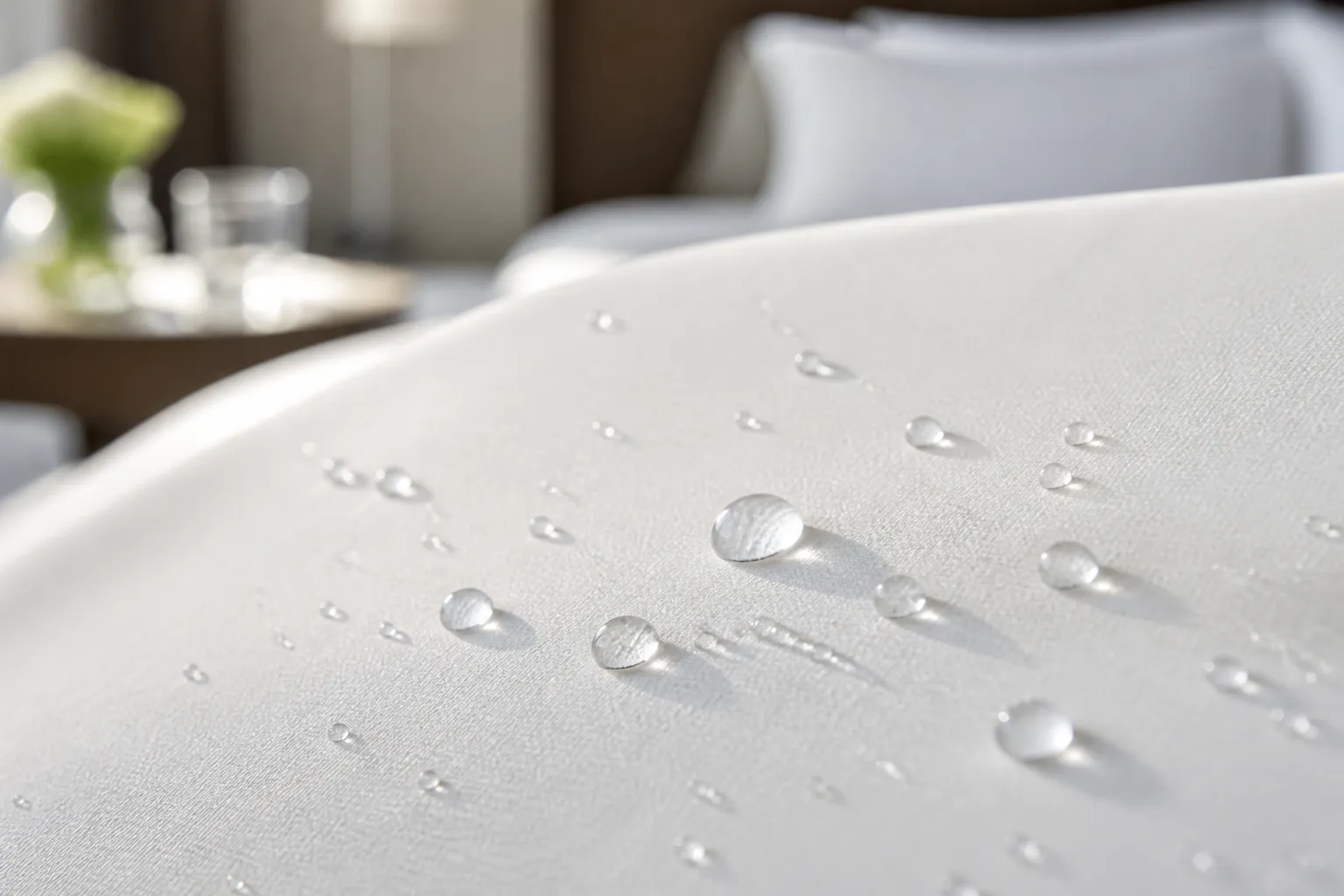
A stain protection treatment applied preventively to a hotel’s fabrics does not stop them getting dirty, but it radically changes how they react to a spill: instead of immediately absorbing the liquid, the treated fibre repels it for a few minutes, giving staff time to act before the stain sets in deep.
This article explains how a stain protection treatment works for hotel fabrics, which areas to treat first, and how long it lasts.
Contents
- How a stain protection treatment works
- Which fabrics to treat first
- Application: when and how to do it
- How long the protection lasts
- What changes in day-to-day stain management
- Limits of the treatment
- When it’s worth investing in this treatment
How a stain protection treatment works
A stain protection treatment, applied with a fabric-specific impregnating product, creates a microscopic barrier around each fibre that repels liquids instead of letting them absorb immediately. The spilled liquid sits on the fabric’s surface for longer, forming droplets that can be blotted and removed before they soak in deeply. It is not a treatment that makes a fabric stain-proof, but one that significantly extends the window of time for acting.
Which fabrics to treat first
Treatment priorities should be set based on stain risk and the cost of replacing the fabric. Armchairs and sofas in common areas, where food and drinks are consumed, are among the first candidates, along with valuable fabrics (rugs, curtains in particular materials) whose replacement would be costly. Room fabrics, such as seating upholstery and headboards, deserve the same treatment in higher-end properties, where visual appearance carries particular weight.
Application: when and how to do it
The treatment should be applied to clean fabrics, never to ones already dirty or stained, because the product would seal in the existing dirt along with the fibre. Good practice is therefore to apply it right after buying a new fabric, or right after a deep clean that brings the fabric to its best achievable condition. Application requires a drying time during which the surface should not be used, a detail to plan carefully for high-use areas.
How long the protection lasts
How long the protection lasts varies with the product used, the type of fabric and how intensively the treated surface is used. In general, a professional treatment stays significantly effective for a few months on high-traffic surfaces, longer on less exposed ones. Periodic reapplication, scheduled alongside the fabric’s deep cleaning, keeps the protection going over time instead of letting it decay unchecked.
What changes in day-to-day stain management
With a treated fabric, staff have more time to deal with a fresh stain, but the basic principle stays the same: the sooner you act, the better the result. Stain protection should be seen as an extra safety margin, not a reason to reduce attention and readiness in dealing with a spill as soon as it is noticed.
Limits of the treatment
Stain protection does not guard against every kind of damage: it does not prevent mechanical wear, fading caused by direct sunlight, or particularly aggressive stains left untreated for hours. It is a tool that reduces the risk of permanent stains from common spills, not a universal solution for fabric preservation.
Our cleaning service for hotels can include assessing and scheduling protective treatments for a property’s most exposed fabrics.
When it’s worth investing in this treatment
Stain protection is particularly worthwhile on high-value fabrics, on high-traffic surfaces in common areas, and in properties where frequent fabric replacement would have a significant financial impact. For a more precise assessment of your specific case, get in touch and let’s discuss it.