


Industrial laundry for hotels: in-house or outsourced
Published on
3 min read
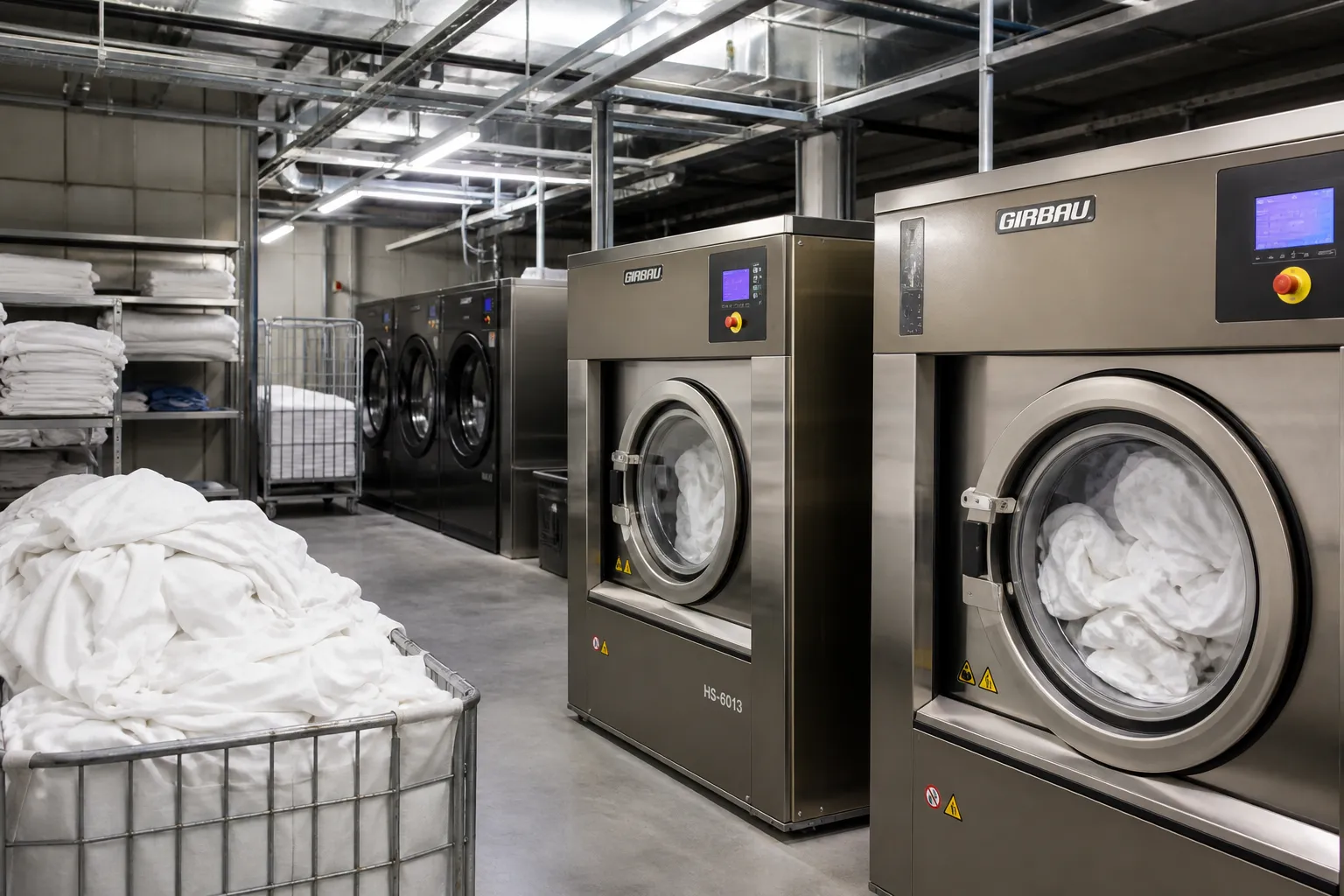
A medium-to-large hotel generates a volume of linen that domestic or semi-professional washing machines can rarely handle: sheets, towels, bathrobes and restaurant table linen add up to quantities that need a purpose-sized facility. The question many properties face is whether an in-house industrial laundry or an outsourced supplier makes more sense.
This article compares the two options, highlighting the factors that tip the balance one way or the other.
Contents
- When a hotel needs an industrial laundry
- In-house laundry: what it requires
- Initial investment and running costs
- The advantages of an in-house facility
- When outsourcing makes more sense
- A hybrid model: what to keep in-house and what to outsource
- How to decide for your property
When a hotel needs an industrial laundry
The threshold beyond which a hotel starts seriously considering an industrial laundry depends on the number of rooms, average occupancy rate and additional services such as a restaurant or spa, which generate further linen to process. Properties above fifty or sixty rooms, or with a restaurant running every day, quickly outgrow what non-industrial solutions can handle.
In-house laundry: what it requires
Setting up an in-house industrial laundry needs a dedicated space, sized for high-capacity machinery (industrial washers and dryers, an ironing calender for sheets and table linen), suitable electrical and water systems, and staff specifically trained to run the facility. This is not an investment that fits into leftover space in the property: it needs designing from the start with specific technical criteria.
Initial investment and running costs
The initial investment for an in-house facility is significant and includes machinery, adapting spaces and systems, plus training dedicated staff. Ongoing running costs also need factoring in: energy and water consumption, machinery maintenance, specific products. This investment only pays off over time if the volume of linen processed is high enough to justify it compared with the cost of an outsourced service.
The advantages of an in-house facility
An in-house facility guarantees direct control over turnaround times, particularly useful for linen that needs to be available quickly (an urgent change, a sudden event), and reduces dependence on an outside supplier for a service critical to daily operations. It also allows more direct quality control, without having to check remotely on the condition of linen processed by a third party.
When outsourcing makes more sense
For smaller properties, or ones with strongly seasonal occupancy, outsourcing to an external laundry service is often more cost-effective: it avoids the initial investment, removes fixed running costs during low-occupancy periods, and shifts responsibility for machinery maintenance to the supplier. We go into this comparison in more detail in another post dedicated to outsourced laundry services for hotels.
A hybrid model: what to keep in-house and what to outsource
Many mid-sized properties adopt a hybrid model: a small in-house facility for linen that needs fast turnaround (towels, bathrobes), and outsourcing for linen that can tolerate longer lead times (sheets, large quantities of table linen). This approach reduces the initial investment while still keeping flexibility for the most urgent needs.
Our cleaning service for hotels also helps evaluate the most suitable linen management model for each property.
How to decide for your property
The choice between an in-house and an outsourced laundry depends on the volume of linen processed, available space, capital available for the initial investment, and the property’s seasonality. A comparative cost analysis over a five-year horizon, including both direct and indirect costs (space, staff, management), is the most reliable way to make this decision rather than relying on a first impression alone.
If you want to evaluate the best solution for managing your property’s linen, get in touch for a discussion.