


Outsourced laundry service for hotels: pros and cons
Published on
3 min read
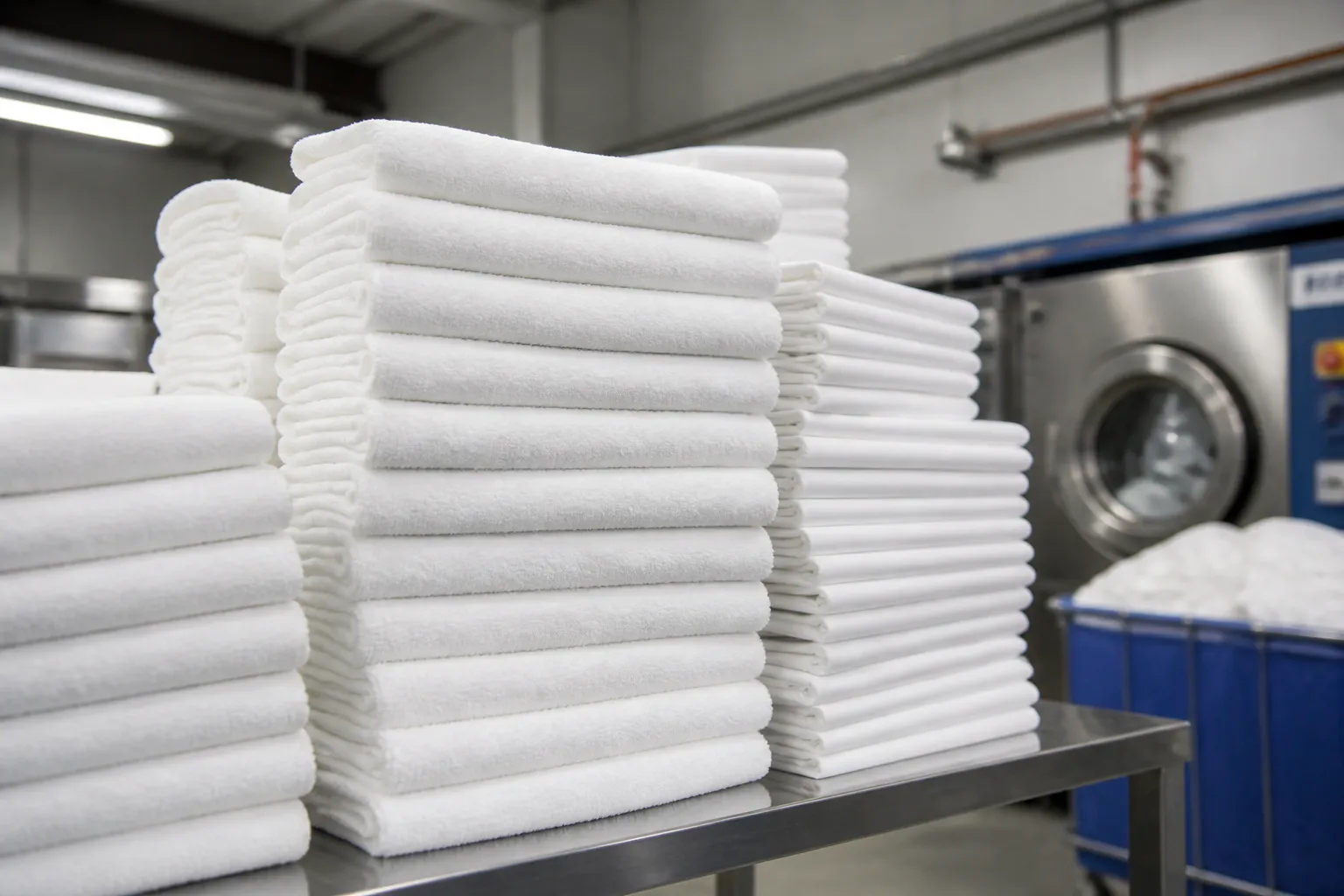
Handing linen over to an outsourced laundry service is the solution chosen by most small and medium-sized hotels, which do not have the volume needed to justify an in-house facility. Like any outsourcing decision, though, it involves a balance between real advantages and a few limits that need managing carefully.
This article looks at the pros and cons of an outsourced laundry service for hotels, and what to check before choosing a supplier.
Contents
- Why most hotels outsource
- The main advantages of outsourcing
- The limits to manage
- Turnaround times and linen stock
- What a laundry agreement should include
- How to evaluate an outsourced laundry supplier
- When an in-house facility makes more sense instead
Why most hotels outsource
For a hotel under fifty rooms, the volume of linen to process rarely justifies investing in an in-house facility: machinery, dedicated space and specialised staff carry a fixed cost that outweighs a pay-per-use service with an outside supplier. Outsourcing means paying based on actual volume, particularly useful for properties with pronounced seasonal occupancy.
The main advantages of outsourcing
Beyond savings on the initial investment, an outsourced laundry service removes machinery maintenance costs, reduces the energy and water consumption charged directly to the property, and shifts responsibility for wash quality and chemical product management to the supplier. For a seasonal property, there is also no need to run a facility during the closed months.
The limits to manage
The most obvious limit of outsourcing is reduced flexibility on timing: linen has to follow an agreed collection and delivery cycle, which rarely offers the same speed as an in-house facility for urgent needs. A second limit is dependence on a single supplier for an essential service: a logistical or operational problem at the supplier feeds straight through into the availability of clean linen at the hotel.
Turnaround times and linen stock
To compensate for the outsourced laundry’s cycle times, a hotel needs to keep enough linen stock to cover the gap between one collection and the next delivery, plus a safety margin to handle the unexpected (a delayed supplier, an unplanned occupancy spike). Sizing this stock correctly is one of the most practical points to define with the supplier from the start of the partnership.
What a laundry agreement should include
A well-structured outsourced laundry agreement specifies guaranteed collection and delivery times, how damaged or lost items are handled, terms for urgent requests outside the standard cycle, and expected quality criteria (wash temperatures, specific stain treatments). A generic agreement, without these details, leaves room for ambiguity that only surfaces once a problem occurs.
How to evaluate an outsourced laundry supplier
Before choosing a supplier, it is worth checking their specific experience with the hospitality sector (different, in volume and fabric type, from residential laundry), their ability to handle seasonal peaks without extending delivery times, and references from other hospitality properties already served in the same area.
Our cleaning service for hotels can coordinate with the property’s outsourced laundry supplier to ensure continuity in linen management.
When an in-house facility makes more sense instead
If linen volume grows beyond a certain threshold, or if the property needs a speed an outsourced cycle cannot guarantee, it may be worth evaluating an in-house facility, as covered in more detail in our post on industrial laundry for hotels.
If you want to evaluate or review your property’s laundry management, get in touch for a no-obligation discussion.